

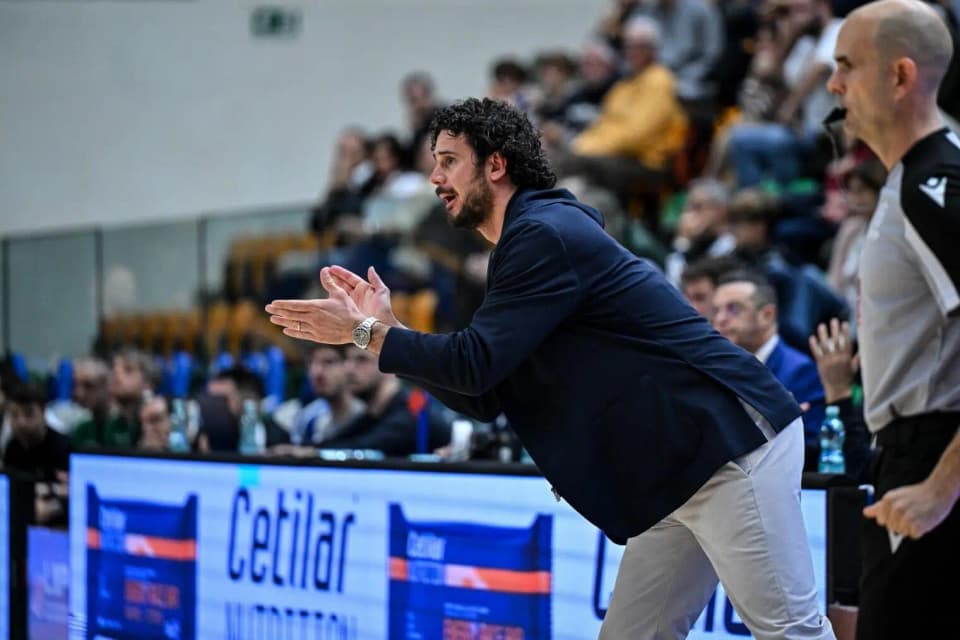
Some defeats leave only questions, while others offer a few more certainties to build on. Dinamo Sassari’s 67-68 loss to Avellino, played on Sunday at the PalaSerradimigni, probably belongs to the second category.
The disappointment remains, because coming back from 14 points down against one of the league leaders only to lose with the buzzer just moments away hurts. But among the defeats in this early part of the season, the one against the Irpini may be the least discouraging in terms of what the team showed on the court.
The team coached by Luca Vitali showed that it can compete with a top-level opponent. At the same time, it confirmed how difficult it still is to maintain a consistent performance throughout the game.
A Dinamo side capable of fighting back
The Banco made a good start, ending the first quarter ahead 19-12, before gradually losing control of the game. Avellino turned the score around and, in the third quarter, went as far as +14.
Dinamo’s response was the most encouraging sign of the evening. The biancoblù stayed in the game, clawed back the deficit and tied it at 67 with a three-pointer by Michele Vitali with less than ten seconds left.
The Dinamo-Avellino game report tells the story of a comeback that did not earn any points in the standings, but showed character and the ability to fight back against a team built to finish near the top.
The challenge now is to sustain that same intensity more consistently. The energy spent overcoming a substantial deficit can leave little margin for error on decisive possessions.
Turnovers tell the story of two different games
One statistic helps show how much the performance changed: Dinamo lost 10 balls in the first half and only two after the break, as coach Vitali explained after the game.
There were eight in the second quarter alone, when Sassari saw its early lead disappear. Those turnovers meant wasted possessions and gave the opponents opportunities to get back into the game.
The response after halftime shows, however, that the team was able to make adjustments. A good second half does not erase the difficulties of one quarter, but reducing mistakes while the game is still within reach is a foundation to build on.
The finish and those details to improve
After the tying three-pointer, Dinamo had two fouls to give before sending Avellino to the line. The biancoblù used them, but on the next possession came the contact between Jeff Brooks and Blake Francis: the American made one of his two free throws, setting the score at 68-67.
The way those final seconds were managed gives food for thought. The issue is not so much the decision to use the fouls, but the timing and composure needed to deny the opponents space and run down the clock without giving them a chance at the free-throw line.
Luca Vitali himself, in his postgame comments, noted that choosing when to foul is something that comes with experience. The coach also expressed reservations about the officiating standard applied to the final contact.
The Dinamo side seen against Avellino is not yet a consistent team, but it has shown a direction. The next step will be to build on what worked, limit lapses and reach close finishes with fewer mistakes to make up for.