

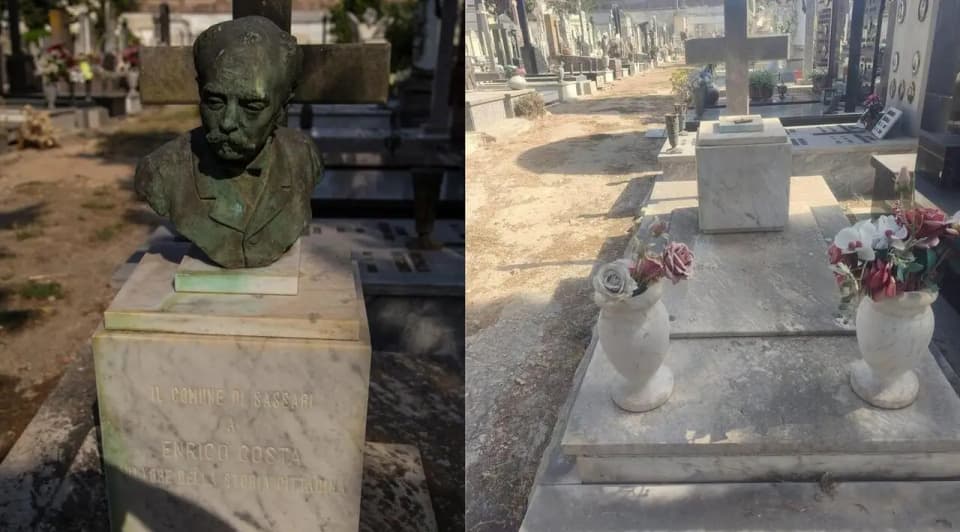
The bronze bust of Enrico Costa has disappeared from the writer’s tomb in the Monumental Cemetery of Sassari. The discovery was reported on Friday, 2 October on the cemetery’s Facebook page, during a site inspection ahead of a walk scheduled for Saturday, 3 October. The announcement described the incident as a theft and appealed for clarification.
The social media post describes the moment when staff, surveying the grounds in preparation for the event, noticed that the work was missing. The post reads: «Unfortunately, we have some bad news. A serious theft has just been discovered during the site inspection for tomorrow’s walk: the bronze bust of Enrico Costa has disappeared from his tomb in the Monumental Cemetery». The news concerns a work placed on the burial site of the Sassari-born writer.
Costa was born in Sassari in 1841 and died in 1909. He was a writer, journalist and scholar, with a strong connection to the city’s history. Among his best-known books is Il muto di Gallura, while his work devoted to Sassari brings together events, figures, traditions and transformations within the community. His work remains an important point of reference for those interested in the city’s memory and its historical figures of Sassari.
This connection with the city is also why the disappearance of the bust carries significance beyond the object’s material value. The statement published alongside the news expresses sorrow at the violation of the memory of a figure who devoted his work to Sassari, and describes the loss as another fragment of history taken from the community. The post thus accompanies the report of the theft with a call for attention to the incident.
The walk connected to the site inspection was scheduled for Saturday, 3 October, at the Monumental Cemetery. The cemetery’s page linked the discovery directly to preparations for the event, explaining how the disappearance came to light during the survey. The report also highlights the bust’s value as part of Sassari’s public memory: Costa’s name remains associated with the works through which he recounted the city’s history and society.