

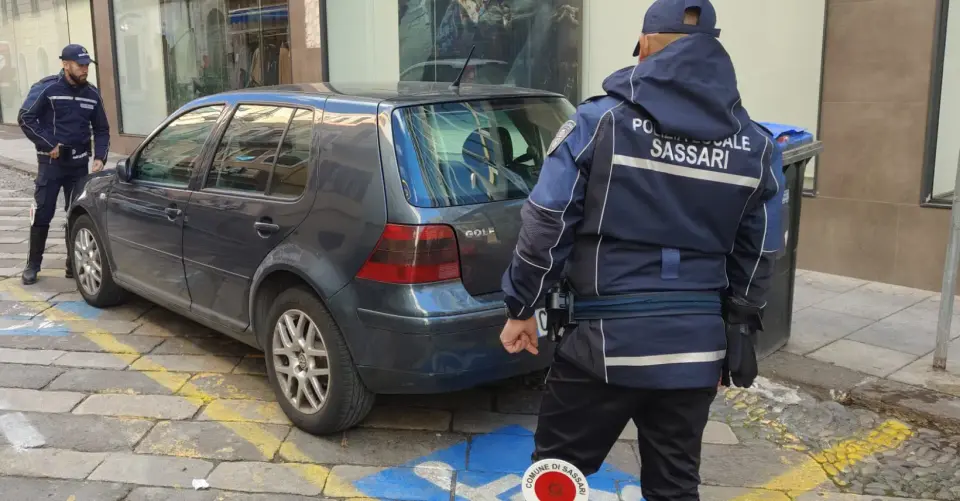
There were 1,104 fines issued in Sassari during the first ten months of 2026 for the improper use of parking spaces reserved for people with disabilities. The figures, released by the municipality on 5 November, cover local police checks carried out across the city to tackle the occupation of spaces intended to ensure independence and accessibility.
According to the administration, checks have been stepped up near the cemetery in recent weeks and, since September, at school entrances and exits. Checks have also been intensified in the city centre and are carried out both by uniformed officers and plain-clothes officers. The municipality describes the operation as part of a broader commitment to safeguard access to public spaces.
The violations recorded include using the spaces for work-related purposes or personal convenience: a mechanic reportedly left a car being repaired in a reserved space, while a pizza delivery driver reportedly used one while waiting for a delivery. In other cases, the spaces were occupied to load materials and equipment, putting individual needs ahead of the reserved purpose of the parking space.
Local police have also reported irregularities involving permits. Photocopied permits reproduced for use with multiple cars were found, as were forged permits, conduct that may have criminal consequences. The municipal statement also reports a permit that belonged to a deceased person and a family member who used a relative’s disability permit without her knowledge.
Enforcement also covers other forms of illegal parking. As of the date of the statement, there were 810 fines for vehicles left on pedestrian crossings and 1,340 for parking on pavements. The municipality also draws attention to vehicles parked in front of curb ramps, which can obstruct people’s passage.
The announcement presents the increase in checks as a response to conduct that harms the community and reiterates the need to continue inspections. Patrols operate throughout the Sassari area, with particular attention to places where occupying parking spaces or pedestrian routes can restrict access to public spaces. Other checks in the historic centre concern the presence of law enforcement in the city.