
Guide · Culture and traditions

Historical figures of Sassari: the people who made history

Cover image for Historical figures of Sassari: the people who made history

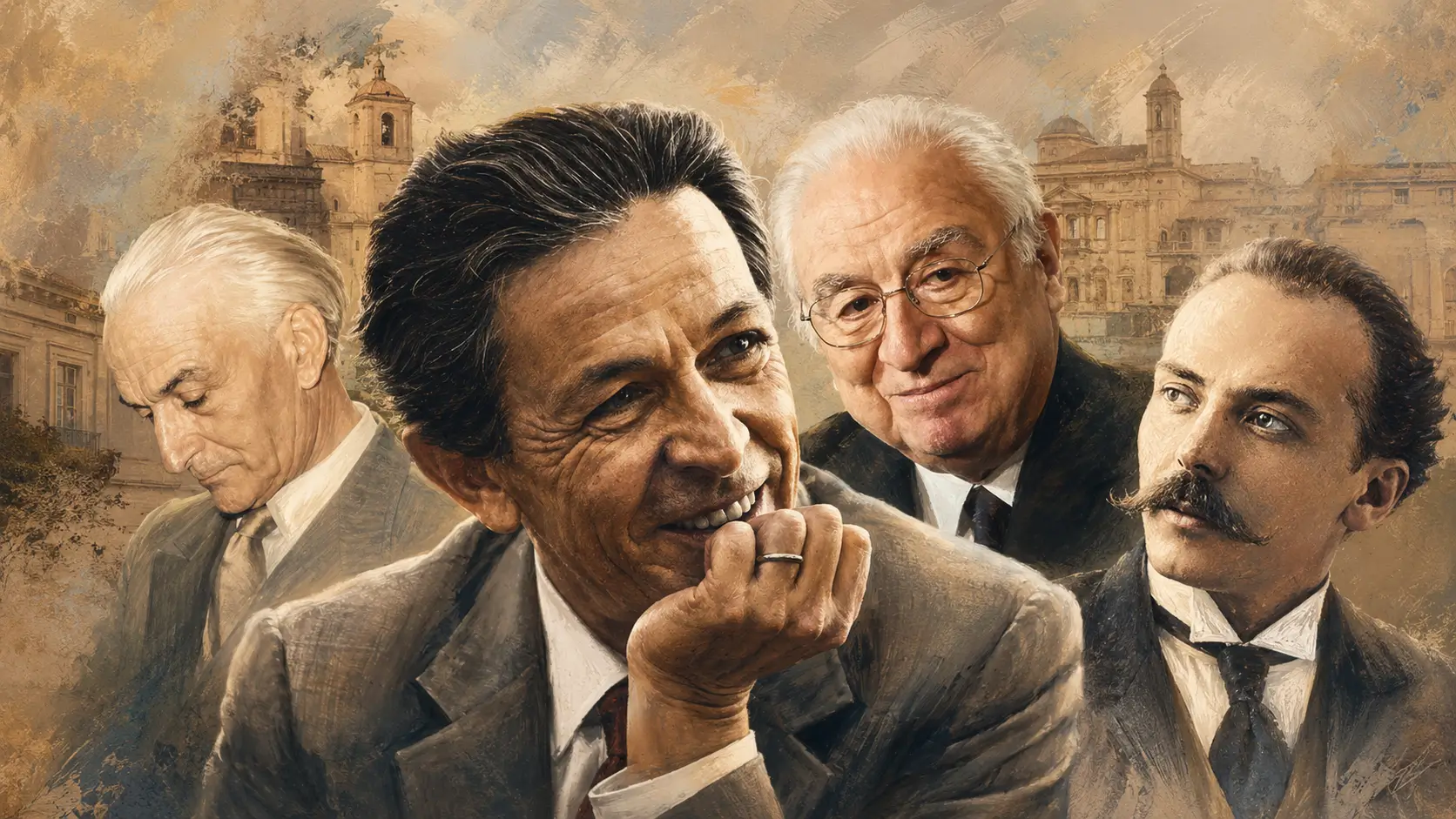
The history of Sassari lives not only in its monuments, squares and folk traditions. It is also shaped by people who, from the city, made their contribution to literature, art, law and Italian politics. Jurists known beyond the borders of the island, writers in love with their city, artists and two Presidents of the Republic: this is a brief guide to some of the most important historical figures from Sassari.

Domenico Alberto Azuni, the Sassari jurist known throughout Europe

Born in Sassari in 1749, Domenico Alberto Azuni was one of the most important Sardinian jurists between the eighteenth and nineteenth centuries. He graduated in law from the Regia Università di Sassari in 1772 and subsequently built a career that took him to Turin, Nice, Paris and Genoa.

His name is chiefly associated with studies of commercial and maritime law, a field in which he achieved international renown. The University of Sassari remembers him as one of the leading figures in its legal tradition and as one of the fathers of commercial law scholarship.

His connection with the city is still visible today: among other things, Piazza Azuni and the historic Liceo Classico Azuni are dedicated to Domenico Alberto Azuni.

Enrico Costa, the man who told Sassari’s story

Few names are as closely linked to the city’s memory as that of Enrico Costa. Born in Sassari in 1841, he was a writer, journalist, illustrator, researcher and archivist. From 1895 to 1909 he worked as archivist for the Municipality of Sassari.

His literary output was extensive, but his relationship with Sassari held a special place in his work. Costa devoted years to studying the city’s history, collecting documents, stories, traditions, events and descriptions of the city.

One of his most significant works is in fact Sassari, a wide-ranging work devoted to the city’s history and urban memory.

It is no coincidence that today the Municipal Historical Archive of Sassari bears his name.

Pompeo Calvia, the poetic voice of late nineteenth-century Sassari

While Enrico Costa told the city’s story through history and narrative, Pompeo Calvia helped give it a profoundly local literary voice.

Born in Sassari in 1857, he was a poet, writer, artist and illustrator. He worked in the Municipal Archive from 1887 to 1917, for several years alongside Enrico Costa, and played an active role in Sassari’s vibrant cultural scene between the nineteenth and twentieth centuries.

His best-known work is Sassari Mannu. Calvia is considered a fundamental figure in poetry in the Sassarese language: Treccani identifies his work as one of the first significant stages in the modern poetic use of Sassarese.

The Municipality still recognises his importance to the city’s culture, having named the study room of the Historical Archive after him in 2024.

Giuseppe Biasi, Sardinia told through art

Born in Sassari in 1885, Giuseppe Biasi was a painter, illustrator and engraver, and became one of the central figures in Sardinian art during the first half of the twentieth century.

Sardinia was one of the fundamental focuses of his artistic research. His works feature people, customs, landscapes, festivals and scenes from island life, reinterpreted through a language capable of engaging with the European artistic movements of the period. His work also extended to North Africa, which he visited in the 1920s.

The relationship between Biasi and Sassari continues through the preservation of his works: an important part of the Sardinia Region collection has been allocated for display at the National Art Gallery of Sassari.

Antonio Segni, from Sassari to the Quirinal Palace

Twice, the political history of twentieth-century Italy brought a person from Sassari to the Quirinal Palace.

The first was Antonio Segni, born in Sassari on 2 February 1891. A jurist and university professor, he studied at the Liceo Azuni and graduated in law from the University of Sassari in 1913. His relationship with the university continued throughout his academic career.

A leading figure in Italian politics after the Second World War, he served several times as a minister and was Prime Minister twice. In 1962 he was elected the fourth President of the Italian Republic, a position he left in 1964 for health reasons.

For Sassari, he represents one of the most prominent political figures in the city’s contemporary history.

Francesco Cossiga, the second President of the Republic born in Sassari

Twenty-seven years after Antonio Segni, the Quirinal Palace welcomed another person from Sassari.

Francesco Cossiga, born in Sassari on 26 July 1928, studied at the Liceo Azuni and graduated in law. Before embarking on a political career, he also taught constitutional law and regional constitutional law at the University of Sassari.

A member of parliament, Minister of the Interior, Prime Minister and President of the Senate, in 1985 he was elected President of the Republic, a position he held until 1992.

The presence of Segni and Cossiga in the history of the Republic is particularly significant: Sassari gave birth to two Presidents of the Italian Republic.

Enrico Berlinguer, from Sassari to national politics

Among the people from Sassari who had the greatest influence on twentieth-century Italian political history, Enrico Berlinguer holds a central place.

Born in Sassari on 25 May 1922, he spent his childhood and formative years in the city. It was in Sassari that he began his political journey: in 1943 he joined the youth organisation of the Italian Communist Party, soon becoming secretary of the local section. The following year he was arrested after taking part in the so-called bread riots, the protests that broke out in the city in January 1944.

His career subsequently took him to the highest levels of the PCI. In 1972 he became the party’s national secretary, a position he held until his death in 1984.

During his leadership, Berlinguer played a leading role in some of the most important developments in Italian politics during the 1970s and 1980s. His name is particularly associated with the strategy of the historic compromise, the search for greater autonomy for Italian communism from the Soviet Union, and reflection on the so-called moral question.

His connection with Sassari, however, predates his national prominence: it was in the city where he was born and grew up that his first political and anti-Fascist experiences took shape.

Together with Antonio Segni and Francesco Cossiga, Berlinguer thus helps make Sassari a city surprisingly present in the political history of the Italian Republic.

Sassari through its historical figures

From Azuni to Costa, from Calvia to Biasi, and finally Segni and Cossiga, these figures tell the story of very different eras and faces of the same city.

There is the eighteenth-century Sassari of legal studies, the nineteenth-century city of archives and cultural circles, the city that found a literary form in its own language, the artistic Sassari of the twentieth century, and finally the city capable of projecting some of its leading figures to the highest levels of Italy’s institutions.

Getting to know the historical figures of Sassari therefore means reading the city’s history through those who studied it, told its story, represented it and carried it far beyond the borders of Sardinia.

Attività consigliate