

Guide · Culture and traditions

Why do people say “a zent’anni” at the Faradda dei Candelieri di Sassari

Cover image for Why do people say “a zent’anni” at the Faradda dei Candelieri di Sassari

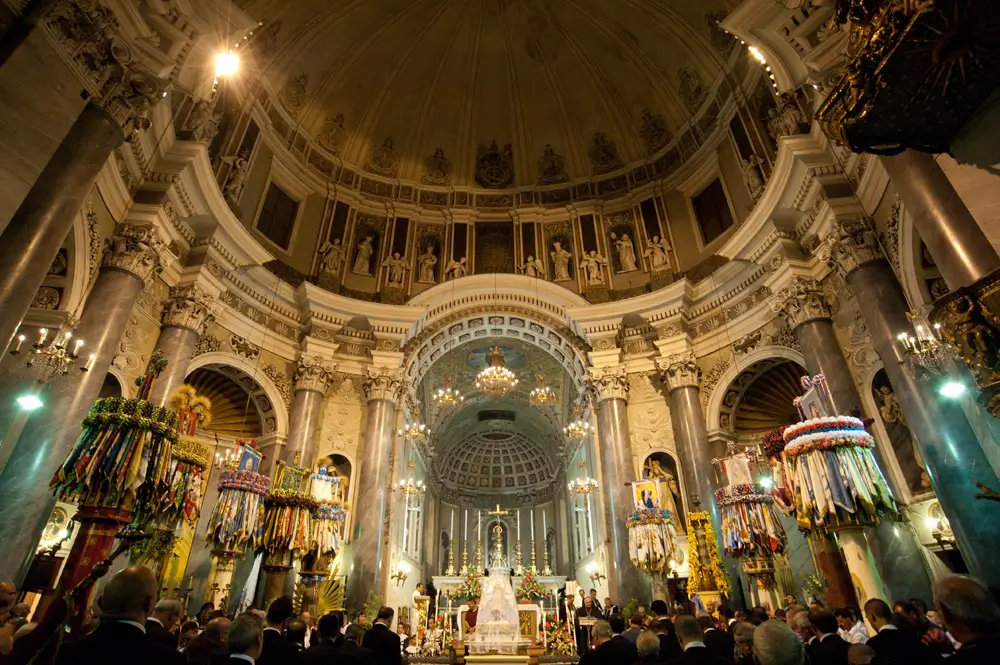
Anyone attending the Faradda dei Candelieri di Sassari for the first time will sooner or later hear two words that, for the people of Sassari, contain much more than a simple toast: “A zent’anni!” Literally, it means “to a hundred years” and is a wish for long life, prosperity and continuity. During the Faradda, however, this expression takes on an even deeper meaning: it is a wish that the city, the Gremi and its festival may come together again, year after year.

What does “a zent’anni” mean

In Sassarese, zentu means one hundred. The expression a zent’anni can therefore be translated as to a hundred years, in the sense of “may it last for a long time” or “may we come together again for many years to come”.

It is not an expression used exclusively during the Candelieri. In Sassarese culture, it may be said as a good wish on happy occasions and at important moments.

It is, however, with the Faradda that these two words have taken on a particularly strong symbolic value, becoming almost one of the festival’s mottos.

The toast between the mayor and the Massai

The best-known moment comes on the evening of 14 August, during the Descent.

The Candelieri set out from Piazza Castello and travel along Corso Vittorio Emanuele II. The procession proceeds from the Gremi that joined most recently to the historically oldest ones.

Bringing up the rear of the procession are the Massai, an ancient Gremio associated with landowners and agricultural activity.

When their Candeliere reaches Palazzo di Città, the Faradda reaches one of its most important institutional moments.

Here, the Gremio of the Massai meets the mayor and the municipal authorities, and the traditional toast is renewed:

“A zent’anni!”

Immediately afterwards, the city authorities join the Descent and accompany the Gremi towards Santa Maria di Betlem.

What is the Intregu?

The toast is closely linked to another fundamental rite of the Faradda: the Intregu.

During the ceremony, the municipal authorities and the Gremio of the Massai exchange their insignia: the Gremio flag and the Gonfalon of the city of Sassari.

It is not merely a formal gesture.

The Intregu symbolically represents the meeting between the city and its Gremi, between the civil authorities and that community of arts and trades that has carried on the tradition of the Candelieri for centuries.

And it is precisely in this context that a zent’anni acquires its fullest meaning.

It is not merely a wish addressed to the people present. It is almost a toast to the continuity of the Sassarese community.

Why one hundred years?

The number one hundred should not be interpreted as an actual deadline.

As with many wishes for long life, “a hundred years” symbolically represents a very long and prosperous future.

During the Faradda, the meaning becomes even more evocative. Every 14 August, Sassari renews a tradition that spans the centuries and once again fulfils its ancient vow to the Assumption of the Virgin.

Saying a zent’anni therefore means hoping that all of this may continue.

May the Candelieri return.

May the Gremi return.

May the city come together once again along the Corso.

And may we be there again the following year.

Is it a way of fulfilling the vow?

No. This is an important distinction.

The a zent’anni toast takes place as the procession passes in front of Palazzo di Città and is one of the civic and institutional moments of the Descent.

The fulfilment of the Vow instead takes place at the end of the route, in the church of Santa Maria di Betlem, where the Candelieri, the Gremi and the authorities arrive.

The Faradda continually brings together two dimensions: the civic, represented by the city and the Gremi, and the religious, linked to devotion to the Assumption of the Virgin.

A zent’anni belongs above all to the moment when Sassari, through the mayor and the Massai, symbolically renews its pact with the festival.

How long has it been said?

A little caution is needed here.

Historical sources allow us to reconstruct the antiquity of the Faradda, the Gremi and the ceremonial relationship between the Massai and the municipal authorities, but they do not allow us to safely assign a precise date to the birth of the expression “a zent’anni” as a ritual formula.

What we do know is that today the toast is an integral part of the traditional Candelieri ceremony and is officially repeated every 14 August.

In the programme for the Faradda 2026, the Municipality of Sassari still expressly lists it as one of the central moments of the Descent.

Much more than two words

For those arriving from elsewhere, a zent’anni may seem simply like a distinctive way of making a toast.

For Sassari, it means something more.

It is a wish addressed to the festival, the Gremi, the city and everyone who experiences it. It is a very concise way of saying that a tradition truly exists only as long as someone continues to pass it on.

And this is probably the best way to understand the phrase.

On 14 August, when the toast comes from Palazzo di Città, a zent’anni means more than just “may we live for a hundred years”.

It also means:

“See you at the next Faradda.”

Attività consigliate