

Guide · Culture and traditions

Museums in Sassari: a guide to the 7 museums to visit

Cover image for Museums in Sassari: a guide to the 7 museums to visit

Sassari is not a city to visit only by strolling through the squares, churches and alleyways of the historic centre. An important part of its history is found indoors, among Nuragic artefacts, paintings, traditional costumes, historic palaces and evidence of the Faradda. The museum offering is also much more varied than it might seem: archaeology, ethnography, modern art, military history, religious culture and Sardinian crafts coexist within a few minutes of one another. Here is a short guide to the main museums to visit in Sassari.

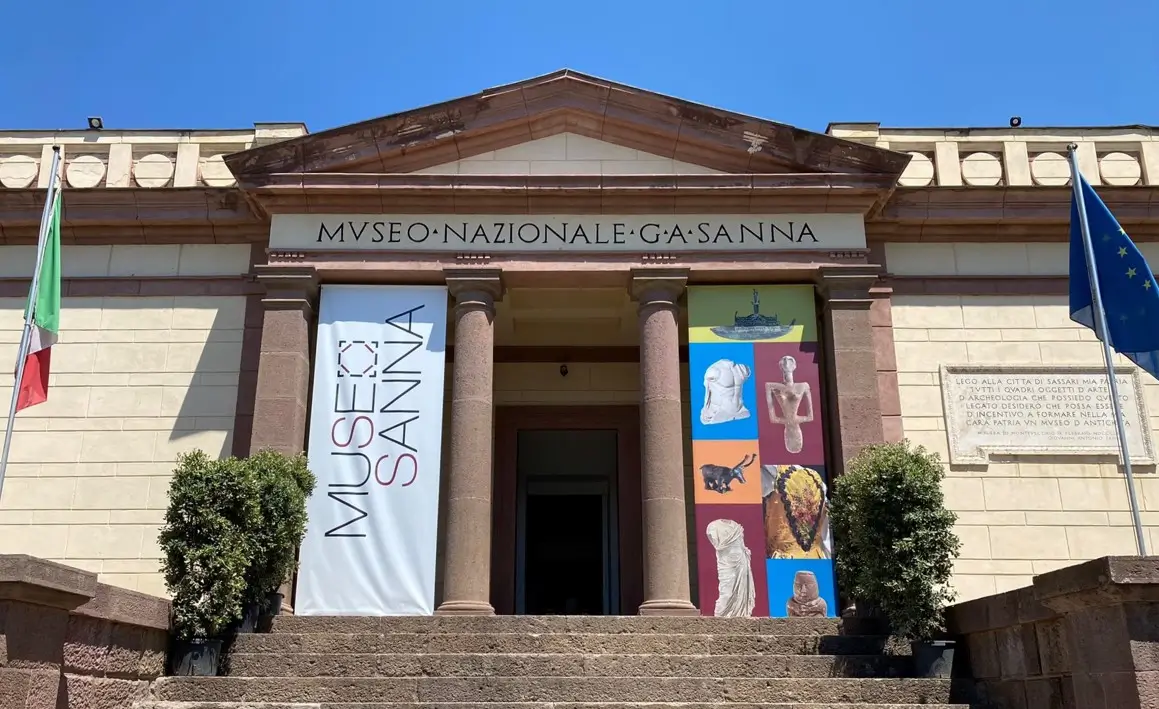
1. “Giovanni Antonio Sanna” National Archaeological and Ethnographic Museum

Ideal for: discovering Sardinia's history from its origins to the Roman era.

The Sanna Museum is the leading archaeological reference point in Sassari and throughout northern Sardinia.

It is located on Via Roma and originated from the collections donated to the city by the Sassarese entrepreneur and politician Giovanni Antonio Sanna, later expanded through excavations, acquisitions and other private collections.

The route spans millennia of history, with artefacts from prehistory, the Nuragic civilisation and the Phoenician, Punic and Roman periods, as well as an important ethnographic collection devoted to traditional Sardinian culture.

Among bronze figurines, ceramics, jewellery, tools and materials from the area's main archaeological sites, this is the museum to choose if you want to understand what existed in Sardinia long before medieval Sassari.

The major new development in 2026

As of 29 April 2026, the Marcialis Pavilion is open to visitors again, completely redesigned.

The new rooms expand the route devoted to the Nuragic, Phoenician-Punic and Roman periods and represent one of the most important updates to the city's cultural offering in recent years.

How much time to allow: at least an hour and a half.

2. National Art Gallery of Sassari

Ideal for: painting, Sardinian art and art history.

In the historic centre, next to the church of Santa Caterina, you will find the National Art Gallery of Sassari.

The museum occupies the former Canopoleno Jesuit College and houses more than four hundred works, in a route spanning several centuries of Italian, European and, above all, Sardinian painting.

The original core once again comes from Giovanni Antonio Sanna's collection, but the holdings have gradually grown through further bequests and acquisitions.

The section devoted to Sardinian artists between the nineteenth and twentieth centuries is particularly interesting, featuring names such as Giuseppe Biasi, Filippo Figari, Antonio Ballero, Carmelo Floris, Mario Delitala, Stanis Dessy and Eugenio Tavolara.

After a temporary closure in the first months of 2026 for energy-efficiency works, the National Art Gallery has resumed operations and is once again taking part in the city's cultural programme.

How much time to allow: about an hour.

3. City Museum at Palazzo di Città

Ideal for: understanding Sassari, the Candelieri and the city's traditions.

If the Sanna Museum tells the story of the area, the City Museum is above all the story of Sassari.

It is housed in Palazzo di Città, the neoclassical building overlooking Corso Vittorio Emanuele II, whose balcony is where the authorities watch the Descent of the Candelieri every 14 August.

The route is divided into two sections.

The western wing explores urban history, the city's memory and the tradition of the Candelieri, with access also to the historic Teatro Civico, a small nineteenth-century gem inspired by Turin's Teatro Carignano.

The eastern wing is devoted instead to traditional clothing, folk festivals and Carnival, with works that help reconstruct daily life between the city and the countryside.

Among the objects preserved here is one of the original seventeenth-century statues from the Rosello Fountain.

For those visiting Sassari for the first time, this is probably the museum that offers the best key to understanding what you will then encounter while walking around the city.

How much time to allow: about an hour.

4. The Duke's Rooms and Cellars

Ideal for: historic palaces, urban archaeology and curiosities about aristocratic Sassari.

Only a few steps separate Palazzo di Città from Palazzo Ducale, now the seat of the municipal government.

Built between the eighteenth and nineteenth centuries for don Antonio Manca Amat, Duke of Asinara, it is considered one of Sassari's most important historic civic residences.

On the ground floor, visitors can see the Duke's Rooms, where objects and evidence connected with the palace's history are displayed. These include sculptures that once decorated the well in the inner courtyard.

The most unusual part, however, lies underground.

The Duke's Cellars lead down into the building's underground rooms, where archaeological excavations have brought to light structures predating the construction of the palace and traces of the neighbourhood's urban development.

The visit is particularly interesting when combined with the nearby City Museum.

How much time to allow: about 45 minutes.

5. Tavolara Pavilion

Ideal for: design, Sardinian crafts and twentieth-century architecture.

Inside the Public Gardens stands one of Sassari's most original buildings: the Eugenio Tavolara Pavilion.

It was designed by Ubaldo Badas and opened in 1956 as the headquarters of ISOLA, the Istituto Sardo Organizzazione Lavoro Artigianale. From the outset, it was intended to show how traditional Sardinian crafts could engage in dialogue with contemporary design.

After major restoration, the Pavilion has once again become a permanent exhibition space devoted to design and Sardinia's craftsmanship.

The collections include ceramics, textiles, jewellery, baskets and other craft products, together with the most important public collection of works by Eugenio Tavolara.

The building alone is worth a visit: large windows, water features, ceramics, a distinctive starry ceiling and the monumental staircase decorated with a depiction of the Cavalcata Sarda.

In 2026, the Pavilion also continues to host numerous temporary exhibitions. During the summer, for example, it is also the focus of a programme dedicated to contemporary art.

How much time to allow: from 45 minutes to an hour.

6. Historical Museum of the Sassari Brigade

Ideal for: contemporary history and the First World War.

In Piazza Castello, inside La Marmora Barracks, stands the Historical Museum of the Sassari Brigade.

The Brigade was established in 1915 and became one of the military formations most deeply connected to Sardinia's contemporary history.

The museum route is arranged in five themed rooms containing uniforms, photographs, documents, weapons, decorations and memorabilia from the places where Sardinian soldiers fought during the First World War.

One of the most evocative spaces is the reconstruction of a trench, designed to convey at least part of the conditions in which infantrymen lived at the front.

The museum also devotes space to the figures and episodes that helped create the myth of the Dimonios.

Admission and the guided tour are free, but booking is recommended. Visits are organised on weekdays at scheduled times.

How much time to allow: about an hour.

7. Diocesan Museum

Ideal for: sacred art and Sassari's religious history.

The Diocesan Museum of Sassari is not housed in a single building.

The route extends between the Cathedral of San Nicola and the nearby church of San Michele, allowing visitors to discover an important part of the city's religious heritage.

In the Cathedral section, between the Aragonese sacristy and the chapter house, vestments, missals, gold and silverware and evidence connected with the city's devotion are preserved, including elements associated with the cult of the Assumption.

The San Michele section, by contrast, includes an art gallery with works from the sixteenth to the eighteenth centuries, sculptures and an archaeological section in the crypt.

Particularly significant is the presence of the bed of the Assumed Virgin, connected with the depiction of the Dormitio Virginis and with the profound Marian devotion that characterises Sassarese religious history.

In 2026, access to the museum is by reservation, so this is a visit to arrange in advance.

How much time to allow: about an hour.

Which museum should you choose in Sassari?

If time is short, the choice can be simple:

  • For archaeology and ancient Sardinia: Sanna Museum.
  • For art and painting: National Art Gallery.
  • To get to know Sassari: City Museum.
  • For a historic palace: Duke's Rooms and Cellars.
  • For design and Sardinian crafts: Tavolara Pavilion.
  • For the history of the Sassari Brigade: Historical Museum of the Brigade.
  • For sacred art and the city's devotion: Diocesan Museum.

A one-day itinerary of Sassari's museums

Most of the museums are in the centre or a short distance away and can easily be included in a walking itinerary.

A good day could begin at the Sanna Museum, continue towards the Tavolara Pavilion and then reach Piazza d'Italia. From here, you can enter the historic centre to visit Palazzo Ducale, Palazzo di Città and, finally, the Diocesan Museum.

The National Art Gallery is a few minutes from the Duomo, while the Sassari Brigade Museum is in Piazza Castello.

To see everything at a leisurely pace, two days are preferable, especially if you want to visit the archaeological and art collections without turning the day into a museum marathon.

Before you go

The opening hours of Sassari's museums are not uniform.

The Sanna Museum and the National Art Gallery are administered by the Ministry of Culture, while Palazzo di Città and Palazzo Ducale are part of the municipal Thàmus network, and the Diocesan Museum and Brigade Museum have their own visiting arrangements.

Public holidays, exhibitions and the summer season may also change opening hours and guided tours.

Before setting out, it is therefore advisable to always check the updated opening hours and find out whether booking is required.

Otherwise, all you need to do is choose which period to start with. In Sassari, you can move from the Nuragic civilisation to the Candelieri, from twentieth-century art to the trenches of the Great War without straying far from the centre.

Attività consigliate