

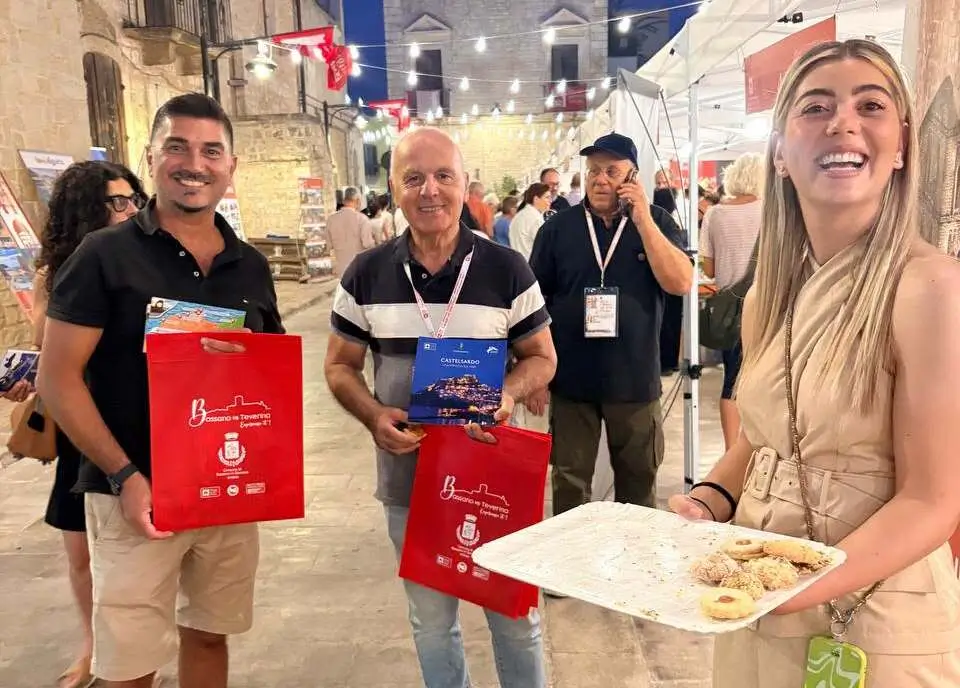
Castelsardo is bringing its history, culture and identity to the national stage. A delegation from the municipality took part in the 18th National Festival of I Borghi più belli d’Italia, held in Sammichele di Bari from 4 to 6 September 2026.
Representing the city of the Doria family were Mayor Maria Lucia Tirotto, Councillor Eleonora Vigliaroni and Tourism Councillor Giuseppe Ruzzu, who is also a member of the association’s national executive board as Sardinia’s representative.
Three days dedicated to the future of Italy’s small towns
The Festival brought together local administrators, tourism operators, businesses and representatives of villages from across Italy.
The three-day event was not devoted solely to tourism promotion. The programme addressed some of the main challenges currently facing small towns: depopulation, heritage protection, sustainability, services, accessibility and new economic opportunities.
Alongside the institutional events, there were performances, workshops, cultural meetings, food and wine initiatives and the Villaggio dei Borghi, designed to showcase Italy’s diverse local identities.
Castelsardo looks to the “Le 100 strade più belle d’Italia” project
One of the projects discussed during the Festival was also “Le 100 strade più belle d’Italia”, an initiative dedicated to itineraries that bring together mobility, landscape and the promotion of local areas.
The Municipality of Castelsardo identified some of the most representative roads in its area in preparation for the project.
The topic was explored in greater depth during a national conference held on 5 September, focusing specifically on new ways of discovering the villages and the opportunities offered by itineraries, cycle routes and slow tourism.
Castelsardo in the network of I Borghi più belli d’Italia
Participation in the Festival strengthens Castelsardo’s role within the national association.
The I Borghi più belli d’Italia circuit officially includes the Castelsardo historic centre, described by the association as a Mediterranean tapestry characterised by the Doria Castle, the narrow streets of the Citadel, the Cathedral of Sant’Antonio Abate and the tradition of artisan weaving.
Membership of the network is above all a promotional tool, but it is also an opportunity to engage with other administrations facing similar challenges, from managing tourist flows to the need to keep historic centres vibrant throughout the year.
Tourism and identity at the heart of the strategy
For Castelsardo, which already offers a particularly rich calendar of events and initiatives during the summer, participation in the Festival therefore provides a further opportunity to strengthen the village’s position in national cultural tourism.
The challenge remains to harness its popularity as a tourist destination without losing the identity of the historic centre and its traditions.
The Sammichele di Bari Festival provided precisely this forum for discussion: to portray the villages not as places frozen in the past, but as communities called upon to find new ways to keep living, attract visitors and create opportunities for the people who live there.