

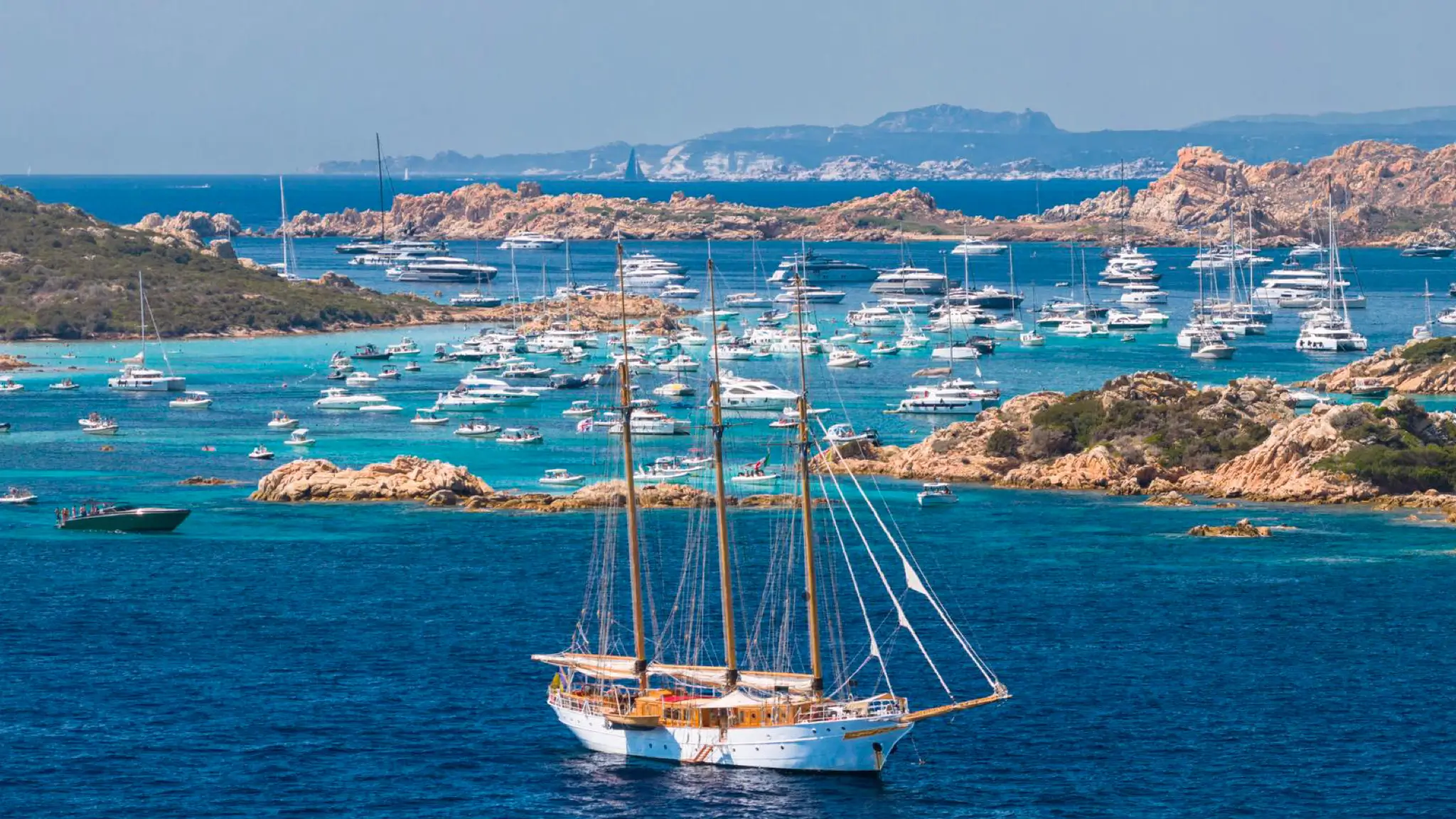
Sardinia is once again having to deal with tourist overcrowding, this time not only on its beaches. In the middle of summer 2026, concern is also growing over the increasing number of yachts, dinghies and recreational boats gathering in the Island’s best-known bays.
One of the most evident cases concerns the La Maddalena Archipelago, where boating pressure during peak days has reached levels far above those considered sustainable for an especially fragile ecosystem.
Thousands of boats in La Maddalena in a single day
The National Park has set a maximum overall limit of 2,500 daily entries under the new rules for rental and charter activities.
The figures observed over the summer, however, tell a very different story.
Park president Rosanna Giudice said that an aerial inspection had counted around 6,500 boats in a single day. The Park Authority’s official website likewise describes pressure reaching around 6,000 vessels a day in the Archipelago.
The concentration is particularly evident in the most famous locations, including Cala Coticcio, Spargi, Budelli, Santa Maria and Caprera.
The risk to Posidonia, the seabed and swimmers
The problem is not limited to the visual impact of bays transformed into large boat parking areas.
One of the most delicate issues is anchoring on the seabed, which can damage meadows of Posidonia oceanica, a vital habitat for the Mediterranean marine ecosystem.
Added to this are vessels too close to the shore, noise, jet skis and the increased difficulty of ensuring swimmers’ safety on days of peak attendance.
For 2026, the Park has tightened the rules on commercial activities at sea, introducing limits on permits and criteria that favor electric boats, less polluting engines and more sustainable systems.
Not just La Maddalena
The phenomenon is not limited to the Archipelago.
In recent weeks, images of Cala di Volpe, on the Costa Smeralda, have also sparked debate, showing dozens of yachts gathered off the coast. Other particularly popular locations, such as Cala Luna, have long used systems to limit overland access in order to reduce pressure on the beaches.
The issue forms part of a broader tourism picture. In 2025, Sardinia surpassed 5 million arrivals and came close to 22 million overnight stays, an increase of 15.9% over the previous year. The regional government itself has acknowledged that in June, July and August some areas of the Island are now close to saturation.
Nautical tourism is worth more than one billion
Limiting pressure does not, however, mean ignoring the economic importance of boating.
According to estimates reported by RaiNews, nautical tourism in Sardinia generates more than €1.2 billion, with around 130 marinas, 15,000 berths and thousands of businesses involved in the supply chain.
The challenge, therefore, is to find a balance between two needs: continuing to benefit from a sector that is fundamental to the Island’s economy while protecting the natural areas that make Sardinia one of the Mediterranean’s most sought-after destinations.
An issue destined to become central
As tourist flows increase, overtourism in Sardinia is no longer only a matter of full car parks, crowded beaches or traffic problems.
The sea, too, has a carrying capacity.
The case of the La Maddalena Archipelago shows how thin the line can become between tourism success and overcrowding. For administrations and conservation authorities, the question in the coming years will therefore be to determine how many people and how many boats can visit the most fragile places at the same time without compromising their environment, safety and quality of experience.