

Guide · Food and flavours

Where to eat fainè in Sassari: 5 places to try

Cover image for Where to eat fainè in Sassari: 5 places to try

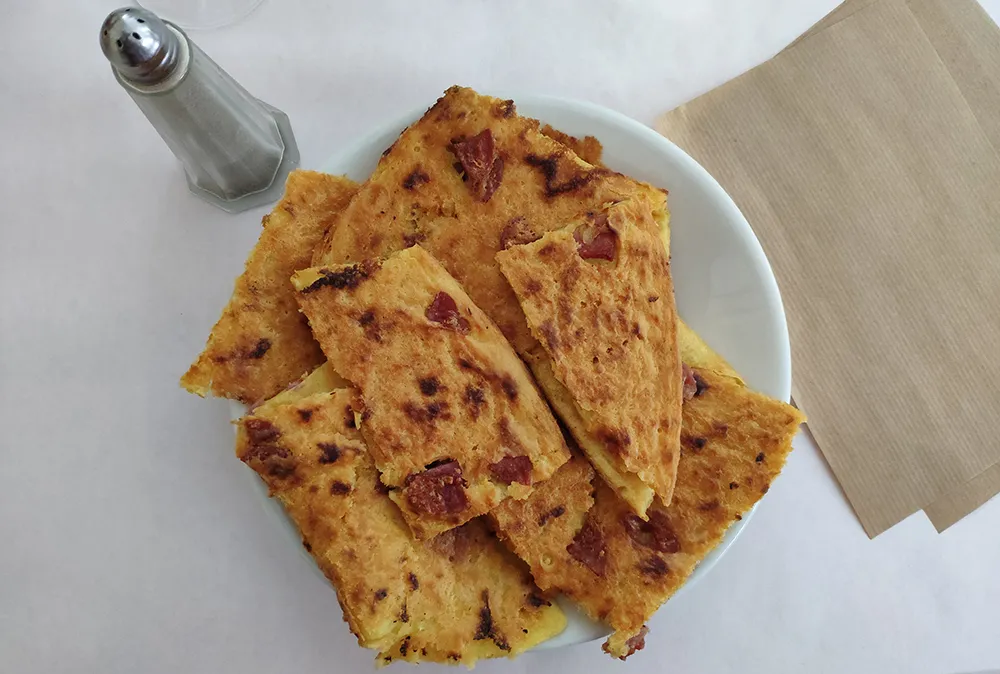
Chickpea flour, water, oil and salt. Four seemingly harmless ingredients that in Sassari have managed to spark decades of debate over which bakery makes the best fainè. Fainè is one of the most characteristic dishes of Sassari cuisine: thin, golden on the surface, soft inside and served piping hot, preferably with a generous amount of black pepper. The classic version is now joined by numerous variations, especially with onion, sausage, mushrooms, anchovies and vegetables. But where should you eat it? Here are five addresses to know.

1. Fainè Sassu

Ideal for: trying the most traditional version in the historic centre.

On Via Usai you will find one of the names historically most closely associated with Sassari fainè: Fainè Sassu.

The place is simple, with no particular concessions to formality. Then again, people mainly come here for one thing, and it certainly is not the tablecloth.

Fainè is served in the classic version and with some of the toppings that have now become part of the city's tradition, such as onion, sausage, mushrooms and anchovies.

The texture is what many people from Sassari look for: thin, with a well-cooked surface and slightly crisp edges.

Gambero Rosso continues to list Sassu among the city addresses where you can get to know this speciality.

Where: Via Usai 17, historic centre.

2. Fainè Da Benito

Ideal for: experiencing the most classic Sassari faineria tradition.

If a discussion about fainè breaks out in Sassari, it is very likely that the name Benito will be mentioned sooner or later.

The place on Via Sant'Apollinare is another city institution and continues to be particularly appreciated for its fainè, served at the table and to take away.

Alongside the classic version, there are versions with onions, sausage and vegetables, as well as the richer house variation.

The atmosphere is informal and the fainè arrives as it should: hot, straight from the oven and without too much ceremony.

The place is not huge, and on busier evenings it may be a good idea to book.

Where: Via Sant'Apollinare 37/A, historic centre.

3. Fainè San Donato

Ideal for: traditional fainè to take away in the heart of old Sassari.

Via San Donato is just a few steps from the Corso and the city's oldest streets.

Here you will find Fainè San Donato, a much smaller place than the historic fainerie, but one that has received particularly positive reviews in recent years.

The formula is simple: fainè, mainly for takeaway, prepared in the traditional Sassari style.

Its location also makes it appealing for anyone visiting the historic centre who wants to try the speciality without arranging a full dinner.

The simple version, made with chickpea flour, water, oil and salt, is also naturally free of ingredients of animal origin. For variations and any specific dietary requirements, however, it is always best to ask the place directly.

Where: Via San Donato 2, historic centre.

4. Missione Fainè

Ideal for: trying more modern interpretations.

The name leaves very little room for doubt.

Missione Fainè is located on Via Duca degli Abruzzi and serves the Sassari speciality alongside other baked preparations.

The approach here is slightly more contemporary than at the historic fainerie, with toppings that go beyond the classic combination of onion and sausage.

Among the variations appreciated by customers are, for example, combinations with guanciale and courgettes.

It is a good choice for those who already know the traditional version and want to see how far you can go starting with a chickpea-based bake.

Where: Via Duca degli Abruzzi 23B.

5. Fainè Pizzeria Da Carlo Pira

Ideal for: fainè and pizza outside the centre.

For the final stop, we head towards Li Punti, where you will find Fainè Pizzeria Da Carlo Pira.

It has long been part of the city's fainè tradition and, unlike the specialised fainerie in the historic centre, serves pizza alongside farinata.

It can be a good alternative for groups in which someone absolutely wants to eat fainè while someone else, inexplicably, does not.

Its location outside the centre makes it more suitable for those already in the northern part of the city or travelling by private vehicle.

Where: Via Nurra 24, Li Punti.

How do you eat fainè in Sassari?

First rule: hot.

Fainè is cut directly from the large baking tray and traditionally served in pieces, with a sprinkling of black pepper.

The basic recipe calls for chickpea flour, water, oil and salt. Regional documentation indicates a traditional thickness of approximately between half a centimetre and one centimetre, with a golden surface and some darker areas caused by cooking.

Then the variations begin.

The most common are:

  • classic, with pepper only;
  • with onion;
  • with sausage;
  • sausage and onion;
  • with mushrooms;
  • with anchovies;
  • with vegetables or other toppings, depending on the bakery.

For a first taste, the advice is to order at least one plain portion. It serves as a scientific reference point for all the discussions that will follow.

Is fainè really a typical Sassari dish?

Yes, although its history leads directly to Liguria.

Fainè belongs to the same family as Genoese farinata and its spread across northern Sardinia is linked to ancient ties with Genoa.

In Sassari, however, the recipe was adopted and transformed until it became an integral part of the local gastronomic culture.

Today, Sassari fainè is officially recognised as a Traditional Agri-Food Product of Sardinia, with Sassari listed among the main areas of production along with Porto Torres, Sorso and Alghero.

Above all, it has developed a ritual of its own: the large baking tray, additions to the batter, pepper, evening consumption and places specialising almost entirely in this dish.

Simply calling it farinata, in front of the wrong person, could therefore spark a discussion longer than the dinner itself.

When to eat fainè

Traditionally, fainè is associated above all with the cooler months and for a long time many bakeries reduced or suspended production during the summer.

Today, some places serve it outside the traditional season too, but opening days and periods may vary.

Before setting out, especially between July and August, it is therefore advisable to check whether your chosen place is open.

Which fainè should you choose?

There is no definitive answer.

Sassu and Benito are the two great names of the city's tradition. San Donato offers an essential experience in the heart of the old city. Missione Fainè allows you to experiment with different toppings, while Da Carlo is a good alternative outside the centre.

The best method remains the one used by generations of people from Sassari: try more than one and decide for yourself.

Naturally, once you have chosen your favourite, you will have to defend it as if it were a personal matter.

Because in Sassari, you can argue about anything when it comes to fainè.

Except the fact that it should be eaten.

Attività consigliate